FERALIXby nanonix

Genetics

From genome
to creature.

Everything a Feralix creature is starts here. This page sets out how the genes are carried, which of them show, how they are passed on, and why a litter looks like its parents.

01 / The genome

618 genes, two copies each.

A creature carries 618 genes on 20 chromosomes. Each gene has two alleles, one from each parent. An allele is either dominant or recessive, and it has a strength drawn from the range that kind of allele can take.

The genes cover far more than looks. By count, the largest groups are mental (172), physical (133), metabolic (89), sensory (41), appearance (37) and body shape (37). Combat, immunity, communication, hormones and gut flora account for the rest.

Genes do not act alone. Many have partners they strengthen, weaken or trade against, so a high value in one gene can matter more or less depending on what sits beside it.

ExpressionGenesWhat the creature shows
Dominant399The dominant allele's strength when there is one; otherwise the average of the two recessives.
Codominant129The average of both alleles.
Recessive56Only when both alleles are recessive. A single copy is carried silently.
Additive24Both alleles added together.
Incomplete10A blend: the dominant allele counts for 65%, the other for 35%.
80 SLOTS

The expression budget.

A creature cannot express everything it carries. It has 80 expression slots, and each gene costs slots according to its tier. The strongest alleles claim their slots first, so a rare, strong allele will show rather than wait behind a queue of cheap ones.
BODY EXCEPTED

Shape reads everything.

The body plan, its parts and its colour are read from every gene's allele strength, expressed or not. A creature never loses its legs to a full budget.

02 / Which genes show

Carried is not
the same as shown.

The expressed genes are the ones that feed stats, conditions, behaviour and temperament. The remainder are still passed on in full, which is how two unremarkable parents can produce something remarkable.

03 / Inheritance

One copy from each.

Breeding follows Mendel. For every gene, each parent passes on one of its two alleles, chosen at random, so a carrier hands on its hidden allele half the time.

MUTATION

Small, and sometimes kind.

Each gene has a chance of about 0.3% of a point mutation when it is passed on. About three mutations in ten improve the allele; the rest do not.

DISORDERS

Carried quietly.

46 genes carry a disorder on a recessive allele. A carrier is healthy. Two carriers bred together can produce a creature with both copies, and the disorder with them.

FOUNDERS

Where a line begins.

A newly founded creature draws each allele dominant 70% of the time, 92% for disorder genes, and at a rate set per gene for the rare colour morphs.

EPIGENETICS

What it lived through.

Stress, enrichment and neglect leave markers. Young inherit them from both parents, averaged and faded, so a hard life casts a shadow one generation long.

04 / Colour

Built in layers,
like the real thing.

A green tree frog is not green. It has yellow pigment cells lying over cells that scatter blue light, and melanin beneath to set how dark it is. Take away the yellow and the frog is blue. A wild budgerigar is built the same way.

Feralix builds colour from the same three parts. The coloration gene sets a pigment from yellow through orange to red. The structural gene sets a blue that leans towards violet as it strengthens. The balance between the structure and the pigment cells decides how far the colour moves from one to the other: yellow over blue passes through green and cyan, red over blue through magenta and violet. Melanin sets the depth.

Every step follows the genes smoothly, so a gene that changes a little changes the colour a little. Young sit near their parents, and colour can be selected over generations. The light tone of the belly and markings leans towards the pigment's own colour, as an unshaded underside would.

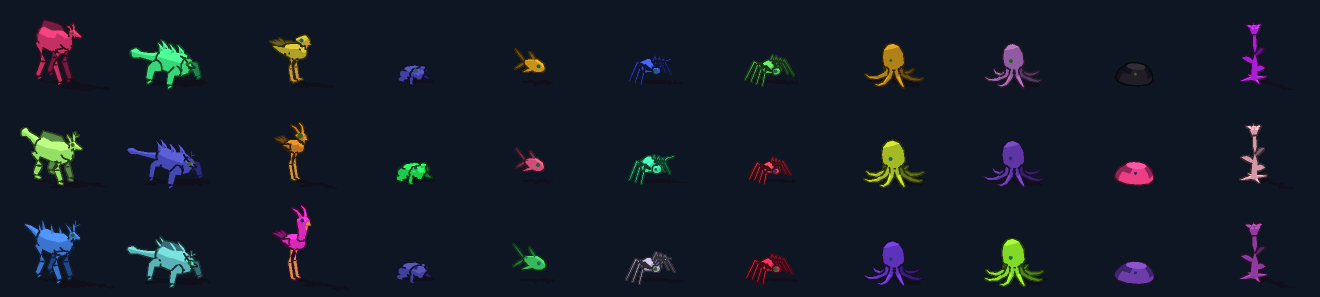
Three founders of each of the eleven types, in a wide spread of colours.
Across 440 founders, every 30-degree band of the colour wheel is occupied.
MorphGeneInheritanceIn 440 founders
Melanistic: black, with a sheen of the colour beneathmelanisticDominant33
Axanthic: no yellow or red, so blue to violetaxanthicRecessive7
Dilute: soft pasteldiluteRecessive39
Albino: white, pink-eyedalbinismRecessive2
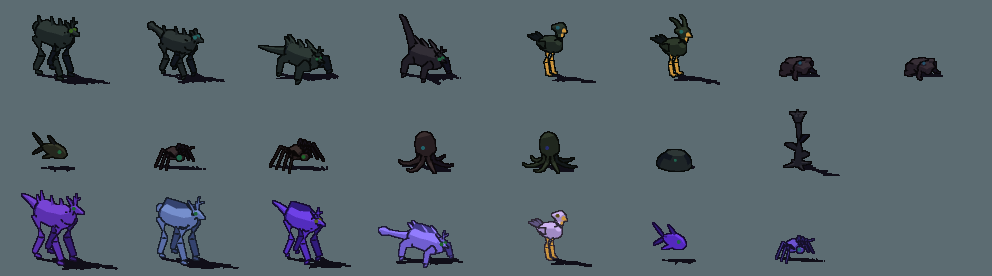
Melanistic creatures in near black, and axanthic creatures in blue and violet.
Melanistic founders (top two rows) and axanthic founders (bottom row).

05 / Rare morphs

Two greens,
one blue.

Axanthism is recessive. Two green parents that each carry one copy will, on average, produce one axanthic young in four, and it will be blue. Neither parent gives any sign of it. A breeder who knows the rule can chase it; one who does not will be pleasantly confused.

Melanism works the other way round. It is dominant, so one copy is enough to turn a creature black, and it is rare in founders for exactly that reason.

Sources

The research behind the colour.

  1. Live Science, "Why frogs are green": livescience.com/4014-frogs-green.html
  2. Susquehanna Wildlife, "Axanthism gives green frogs the blues": susquehannawildlife.net/?p=16694
  3. Australian Geographic, "Mutant blue frog excites ecologists" (2024): australiangeographic.com.au
  4. Wikipedia, "Budgerigar colour genetics": en.wikipedia.org/wiki/Budgerigar_colour_genetics
  5. Wikipedia, "Blue budgerigar mutation": en.wikipedia.org/wiki/Blue_budgerigar_mutation
  6. Cosmos, "Gene mutation gives budgerigars their colours": cosmosmagazine.com
  7. St Olaf College, quantitative genetics notes: pages.stolaf.edu (PDF)
  8. Quantitative genetic aspects of coat colour in horses: bib.irb.hr/261714